

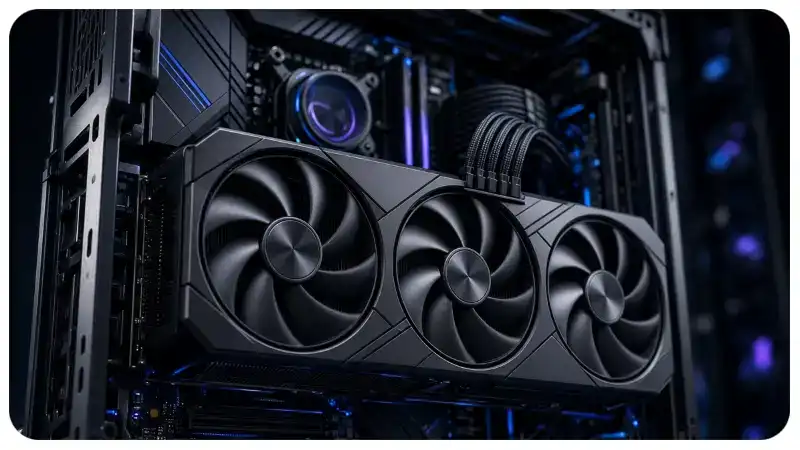
Looking for the full rtx 5090 specs? You came to the right place. NVIDIA’s new flagship graphics card packs serious power, and the rtx 5090 specs show exactly why it sits at the top of the heap.
This card launched in late January 2025 at $1,999. It brings the Blackwell architecture to gamers and creators who want the absolute best. In this guide, I break down every important number, feature, and real-world takeaway in plain language. No fluff. Just the facts you need.
Core RTX 5090 Specs at a Glance
Here are the key rtx 5090 specs that matter most:
- GPU: GB202-300 (Blackwell architecture)
- CUDA Cores: 21,760
- Ray Tracing Cores: 170 (4th generation)
- Tensor Cores: 680 (5th generation)
- Base Clock: 2,017 MHz
- Boost Clock: 2,407 MHz
- Memory: 32 GB GDDR7
- Memory Bus: 512-bit
- Memory Speed: 28 Gbps
- Memory Bandwidth: 1,792 GB/s
- Total Board Power: 575 W
- Power Connector: 1 × 16-pin
- Recommended PSU: 1,000 W
- Interface: PCIe 5.0 ×16
- Process: TSMC 4N (4 nm)
- Die Size: 750 mm²
- Transistors: 92.2 billion
- Display Outputs: 3 × DisplayPort 2.1b + 1 × HDMI 2.1
These numbers come straight from NVIDIA and match independent reviews. The jump from the RTX 4090 is clear in cores, memory size, and bandwidth.
Breaking Down the RTX 5090 Specs in Detail
Let’s walk through what each part of the rtx 5090 specs actually means for you.
CUDA Cores and Clock Speeds
The card runs 21,760 CUDA cores. That is roughly 33% more than the RTX 4090’s 16,384 cores. Base clock sits at 2,017 MHz and boost reaches 2,407 MHz. Raw compute power climbs past 100 TFLOPS in FP32. Games and creative apps that use lots of parallel work feel the difference right away.
Memory System
NVIDIA moved to 32 GB of GDDR7 on a full 512-bit bus. Effective speed hits 28 Gbps. The result is 1,792 GB/s of bandwidth—almost 80% more than the previous flagship. High-resolution textures, large AI models, and 8K video editing stay smooth because the memory can keep the cores fed.
Ray Tracing and AI Hardware
Fourth-generation RT cores number 170. Fifth-generation Tensor cores number 680. Together they deliver strong ray-traced lighting and AI features. DLSS 4 with Multi Frame Generation is the big new tool. It can generate multiple frames between rendered ones, which lifts frame rates a lot in supported games while keeping image quality high.
Power and Cooling
Total board power lands at 575 W. That is 125 W higher than the RTX 4090. NVIDIA redesigned the Founders Edition cooler so the card still fits in two slots. Two fans and a clever PCB layout keep temperatures under control. Most systems need a solid 1,000 W power supply. One 16-pin connector handles the load.
Key Features That Stand Out
Beyond the pure rtx 5090 specs, a few features make the card special.
DLSS 4 brings Multi Frame Generation. You can push high refresh rates on 4K or even 8K monitors without dropping quality as much as before. Reflex 2 cuts system latency for competitive play. The card also carries three 9th-generation NVENC encoders and two 6th-generation NVDEC decoders. Streamers and video editors get faster encode and decode, plus solid AV1 support.
Display support reaches 4K at 480 Hz or 8K at 165 Hz with DSC. You can run up to four monitors at once. PCIe 5.0 ×16 future-proofs the connection for upcoming motherboards.
The Founders Edition measures about 304 mm long and stays dual-slot. That makes it easier to fit in many cases compared with some earlier flagships. Partner cards vary in size and cooling, of course.
Performance Expectations
In real games the card delivers clear gains over the RTX 4090. At 4K with ray tracing and DLSS 4 active, frame rates often jump 50–100% or more depending on the title. Rasterization performance rises too, though the biggest leaps appear when AI and ray tracing work together.
Content creators see big wins in 3D rendering, AI image generation, and video timelines that use heavy effects. The extra 8 GB of faster memory helps with large projects that used to stutter or crash on previous cards.
Power draw stays high. Expect higher electricity use and more heat than last generation. Good case airflow and a quality power supply remain important.
Who Should Buy the RTX 5090?
This card targets enthusiasts who play at 4K or higher, streamers who want the best encode quality, and creators who need maximum VRAM and speed. If you game mostly at 1440p or care more about value, lower models in the 50-series make more sense for most people.
Price sits at $1,999 for the Founders Edition. Partner cards often cost more, especially overclocked or premium-cooled versions. Stock was tight at launch, so availability can still vary.
Final Thoughts on the RTX 5090 Specs
The rtx 5090 specs confirm NVIDIA’s new flagship as a serious leap in cores, memory, and AI features. 21,760 CUDA cores, 32 GB of GDDR7, and 1,792 GB/s of bandwidth set a new high bar. Pair that with DLSS 4 and the card handles today’s most demanding games and workloads with room to spare. If you want the absolute top of the line and your system can handle the power, this is the card to get.








Leave a Reply